
Buying AMIRI Online Without Being Taken In
AMIRI, a Los Angeles house, has everyday pieces logged roughly between $420 and $1,300 in market listings, and that is exactly the band counterfeit sellers work hardest to imitate. Two channels sit with the brand itself, its website and a published list of authorised stockists, and almost everything beyond them warrants a second look. Searches like buy amiri online, amiri clothing, amiri hoodie and amiri men land shoppers on a results page where department stores, marketplace resellers and outright fakes sit within a few positions of each other. Channel by channel, this guide makes clear plainly what each one really is. Each figure quoted here derives from observed market pricing gathered in 2026 and is not an official price list. The single most useful habit is to check any unfamiliar seller against the brand’s own published stockists page before entering a card number.
The House’s Own Website
A single official e-commerce operation is run by the house, and it is the only online shop the brand itself controls. More than two hundred countries and regions are served, with the full current assortment across men’s, women’s and kids’. The returns window is ten days from delivery for unworn merchandise with tags attached, and final-sale items are excluded. Case by case is how after-sales service and repairs are handled, and only for products bought from that site, with repair fees possible. That same operation lies behind roughly thirty-three physical boutiques, a number of which the store locator still marks as coming soon. The first permanent store opened on Rodeo Drive in Beverly Hills in 2020, and Milan later became the first permanent European location.
The Authorised Multi-Brand Retailers
A stockists page is published by the brand, and every retailer named there holds a direct wholesale relationship with the house. In the United States that list couples department stores with specialist boutiques, and in Europe it runs to dozens of accounts, Italy carrying the longest single-country roster. What makes the list valuable is not lower prices, since at full price these shops are no cheaper, but the fact that their goods are unambiguously genuine. There is one caveat that matters a great deal, simply that amiri ripped jeans the stockists page is not closely maintained. It still names a well-known British retailer that shut down in 2024, and it carries several obvious misspellings of shop names, which tells you it is treated as marketing rather than as a live directory. Use it as a whitelist of names to recognise, never as proof that a given shop is still trading.
- Listed on the brand’s own online roster: Mr Porter, SSENSE, Mytheresa, LuisaViaRoma, Browns, END., 24S, Monnier
- Within the United States: Nordstrom, Saks Fifth Avenue, Neiman Marcus, Bergdorf Goodman, Maxfield, The Webster
- Outside that market: Selfridges, Harrods, Harvey Nichols, Holt Renfrew, Galeries Lafayette
Where Farfetch Fits
Farfetch is the channel that confuses people most, and the honest answer is that it belongs in neither obvious box. It is not named on the brand’s own online stockist list, so calling it an official stockist goes too far. It is also not an unauthorised seller, because it operates as a marketplace for boutiques that are themselves named stockists, several of them Italian. In practice the garment often ships from a shop with a genuine wholesale account even though the storefront itself has no listing. That nuance is worth preserving, since most guidance flattens it in one direction or the other. Should you buy there, determine which boutique is fulfilling the order and whether that name appears on the stockists page.
Off-Price and Sale Channels
Any piece suggesting this brand never discounts is simply wrong, and that discounting shapes everything else in the market. Visible in-season markdowns come from authorised multi-brand retailers, with observed reductions somewhere around forty to seventy percent on jeans, hoodies and outerwear. A jean listed at $1,345 has been spotted at $673; a varsity jacket listed at $2,310 has been observed at $1,155. Off-price arms of established retail groups, Saks OFF 5TH among them, also carry the label and sell past-season stock at steep reductions. Legitimate is the right word for those goods, and the seller is a real retailer working through surplus, not a front. That channel is emphatically not a brand outlet, and the distinction drives the whole of the next section.
The Outlet Nobody Has Ever Operated
This is the most important fact in the article, and it comes from the brand itself in a court filing rather than from a blog. In a federal court complaint filed in July 2021, AMIRI stated that it “does not have an AMIRI outlet store, nor has it ever authorized any person or business to operate such a store.” The suit was brought in the United States District Court for the Central District of California against an internet service provider the brand alleged was knowingly hosting a counterfeit-selling site styling itself as an AMIRI outlet. That site branded itself an “Official Discount Store” advertising “100% Original Products” and claimed to stock more than a hundred authentic pieces at heavy discounts. In September 2021 the case was voluntarily dismissed, most likely on settlement, yet the brand’s statement remains on the record. There is therefore no official outlet, online or physical, anywhere. By definition, any storefront presenting itself as an AMIRI outlet is not the brand, and that single test disqualifies it before you weigh anything else.
How a Fake Outlet Site Gives Itself Away
The storefronts share a template, and the pattern is hard to unsee once you have registered it. The tells below are drawn from the documented 2021 case and from the general shape of such operations, and they are sketched rather than listed, because naming a domain sends traffic to it. On its own no single item proves anything; three or four at once are decisive. The strongest test is still absence from the brand’s published stockists page, and running it takes about fifteen seconds. Next comes the discount pattern: no authorised channel cuts current-season stock across every category at once. Give the checkout page the same attention as the product page, because payment handling is where these operations most often show their hand.
- A name welded together from the brand name and a trust word such as outlet, official, shop, store or sale
- Badges the site awards itself: “Official Site”, “Official Discount Store”, “100% Original Products”, “Authentic Guaranteed”
- Sitewide discounts of fifty to eighty percent that include current-season pieces
- An improbably deep catalogue shown through scraped official campaign photography
- Absence from the stockists page, with no proof in the way of company registration, address or telephone number
- Timers ticking away, “only two left” mechanics, and a payment processor whose name does not match the shop
Weighing the Channels
Two questions matter, and the table measures every channel against both: are the goods certainly genuine, and what will you pay against full price. Observed behaviour in 2026 is what the pricing column reports on; it is not an official price list. Authentication risk is a judgement about the channel, not a promise about any individual seller inside it. The brand will only verify products bought directly from it or from an authorised stockist partner, and it says plainly that it cannot authenticate items bought outside those channels. That policy is why provenance matters more than micro-inspection of stitching as the thing to optimise for. Read the final row as an absolute rather than as a caution.
| Type of seller | Status | Prices seen | Risk to authenticity |
|---|---|---|---|
| The house’s own shopfront | Official | Full price | None |
| The stockists the brand names | Wholesale, officially held | Full price, then seasonal sale | As low as it gets short of none |
| Farfetch | Marketplace whose boutiques are stockists | Full price as well as sale | Low, provided you check the fulfilling boutique |
| The off-price arms run by retail groups | Legitimate, past-season stock | Marked down 40 to 70 percent | On the low side |
| Second-hand platforms | Peer-to-peer | Below retail more often than not | Real, and different from platform to platform |
| Any shop calling itself an outlet | No such thing exists | Irrelevant | Complete |
A Pre-Checkout Routine
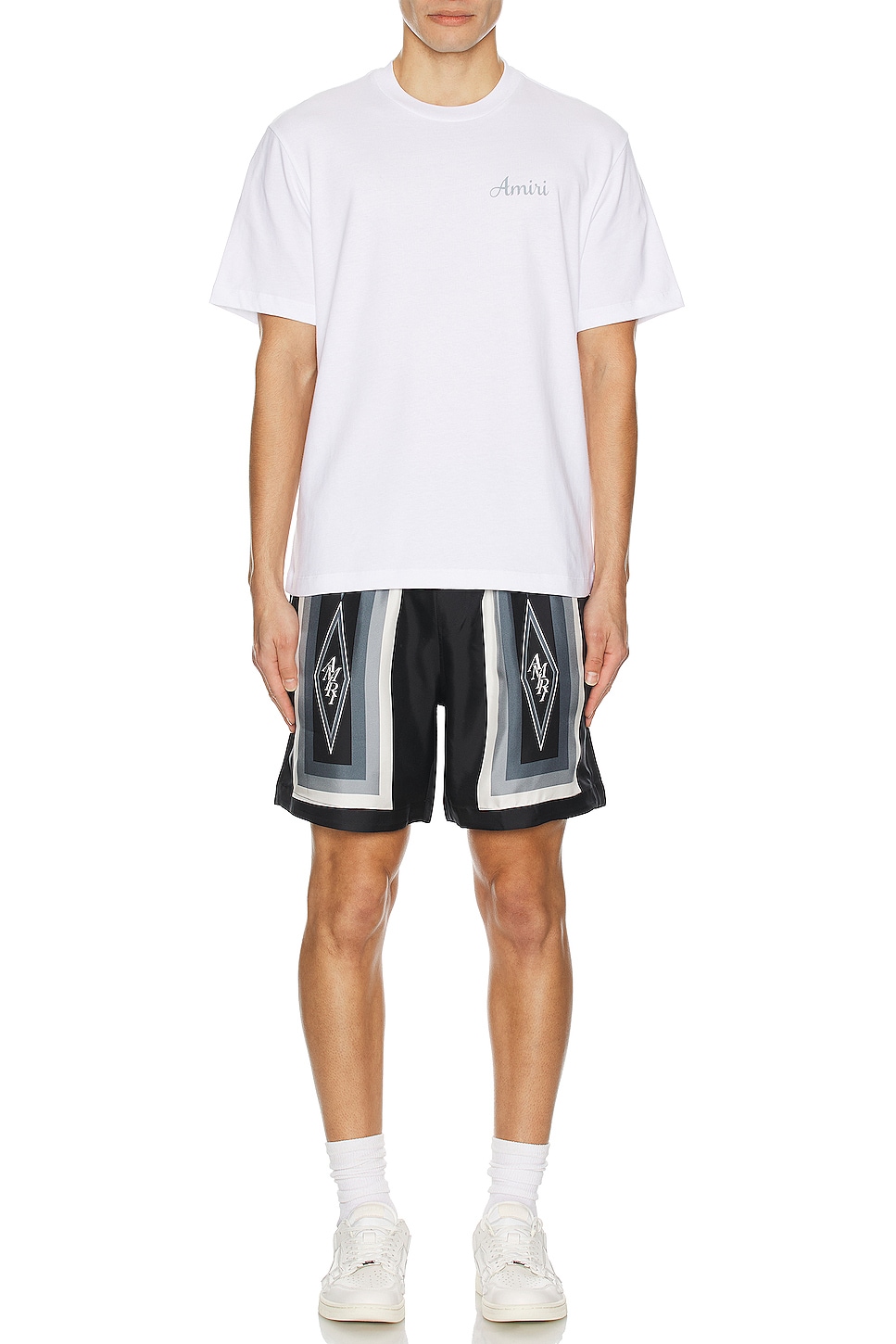
Complexity is not required here; the whole check runs shorter than choosing a size. Start by asking whether the shop’s name appears on the brand’s published stockists page, and treat a marketplace as requiring one extra question about who is fulfilling the order. Turn then to the discount, since current-season amiri jeans at seventy percent off from an unfamiliar storefront reads as a signal rather than a bargain. Check that the stated country of origin is plausible for the style, since origin varies by product and a mismatch is one of the more reliable red flags. Hold on to the order confirmation and the invoice, as proof of purchase is what the brand’s verification policy runs on. And should a site call itself an outlet, shut the tab.